Career Change
Should You Change Careers? Use a 30-Day Experiment Before You Make a Big Decision
You do not need to choose a perfect new career from your desk. Use a 30-day career experiment to test the work, the skills, and the trade-offs before making a high-stakes move.
657 words · 4 min read
Career change advice often jumps from “I am unhappy at work” to “choose a new field.” That leap is too big for most real lives. A better first move is smaller: learn what you need to know before you make an expensive or irreversible decision.
The need is visible in public career conversations. In a recent Hacker News discussion about the job market, people described unstable roles, highly technical requirements, and experienced workers considering consulting or starting something of their own. When the market is uncertain, a career decision needs more than a list of attractive job titles. It needs evidence about the work, the constraints, and your actual energy for it.
Separate the problem from the career title
Before researching a new field, name what is pushing you away from your current situation. Is it:
- the work itself?
- your manager or organization?
- lack of autonomy?
- income volatility?
- a skills ceiling?
- burnout or workload?
- a location, schedule, or caregiving constraint?
If the real problem is a bad environment, switching fields may not solve it. If you enjoy the work but need a different setting, a role change inside the same field may be the smarter experiment.
Compare three options, not two
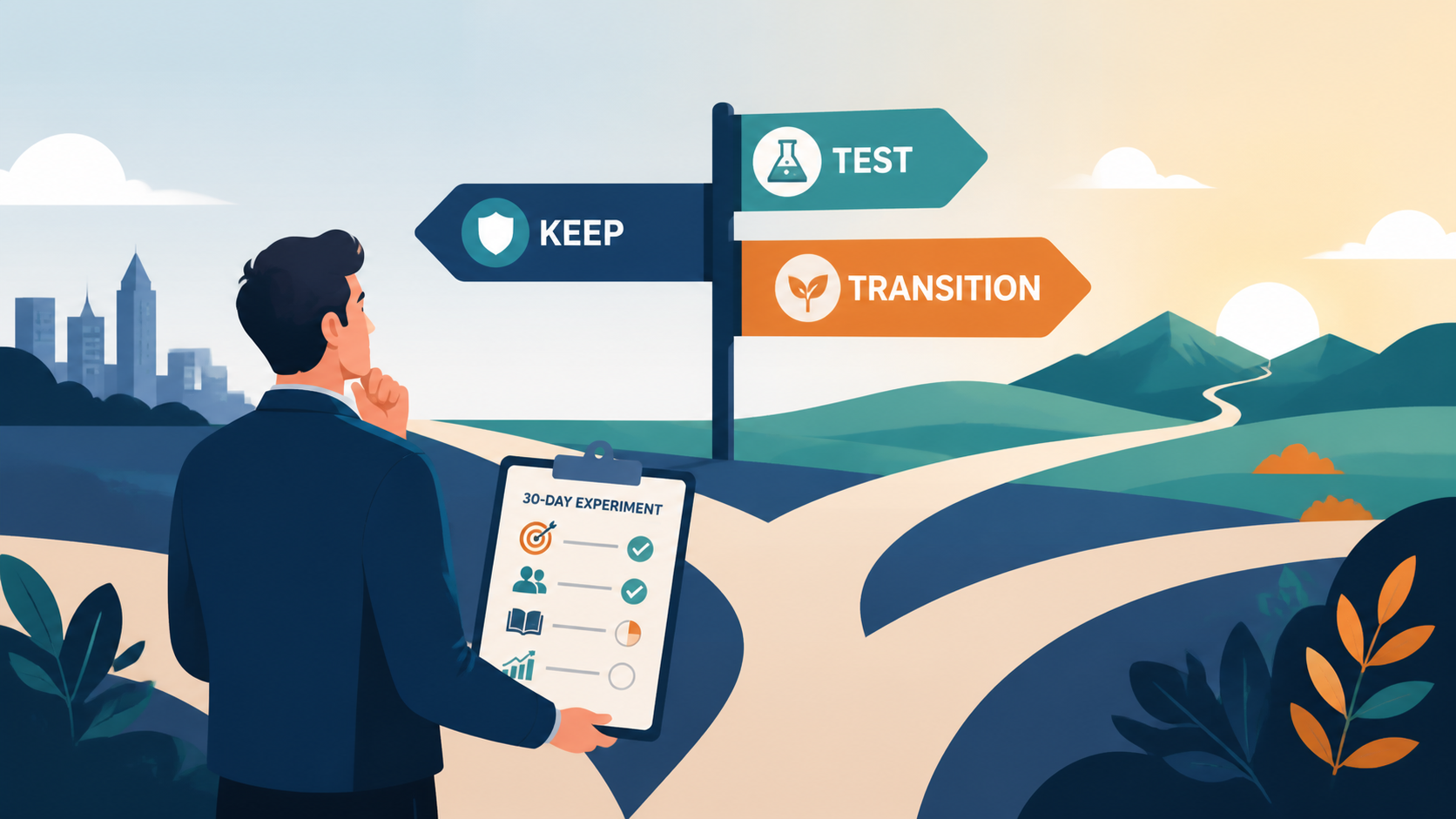
People commonly compare only “stay” and “quit.” Add a third lane: test.
1. Keep and redesign
Could you change team, scope, hours, manager, location, or type of employer while retaining your existing career capital?
2. Test an adjacent direction
Could you try a related role where your current experience transfers? A customer success manager might test enablement; a teacher might test learning design; an analyst might test operations or product research.
3. Transition deliberately
If the target work is meaningfully different, what training, portfolio, credential, income buffer, and timeline would make the move responsible?
This comparison reduces all-or-nothing thinking. It also reveals whether you are drawn to a new career—or simply desperate to leave a difficult current situation.
Design a 30-day career experiment
A useful experiment is specific enough to produce evidence and small enough to finish. Choose one target direction and complete four actions over 30 days.
Week 1: Study the daily work
Read 15–20 real job descriptions. Do not just collect titles. Highlight recurring tasks, tools, collaboration patterns, and output expectations. Ask: *Would I enjoy this work repeatedly, not just the idea of this title?*
Week 2: Talk to two people
Speak with people doing the work or adjacent work. Ask what takes up their time, what surprised them, what beginners misunderstand, and what makes someone effective. You are not asking for a job; you are checking assumptions.
Week 3: Make one piece of evidence
Complete a small work sample: analyze a public dataset, redesign a simple onboarding flow, write a customer research brief, create a lesson, or solve a realistic case. The point is not perfection. Notice whether you can tolerate and enjoy the process.
Week 4: Review the trade-offs
Score the experiment from 1–5 on interest, energy, skill fit, access to opportunities, income path, and lifestyle fit. Then write one of three conclusions: continue testing, pursue an adjacent path, or pause the idea for now.
Make decisions from evidence, not pressure
A 30-day experiment does not need to prove that a new career is “the one.” It only needs to answer a better question: *Is this direction worth a larger next investment?*
That can protect you from spending months retraining for work you have never tested. It can also show you that your current skills are more transferable than you expected.
Your next step
If you need language for your interests, values, strengths, and preferred work style before choosing an experiment, take the free AI Career Test. Treat the result as a starting point for investigation—not a command or a single permanent answer.
*AI Career Test provides informational self-exploration and job-search preparation. It is not professional career counseling and does not guarantee employment outcomes.*